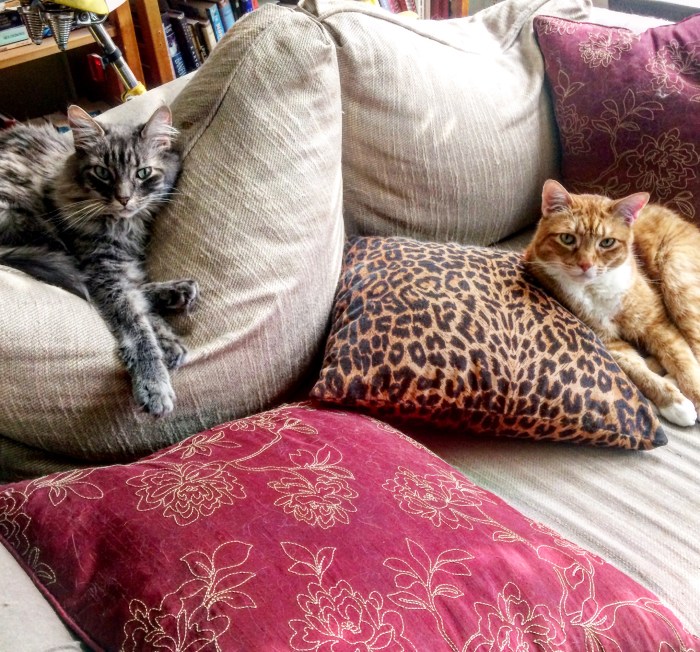
~Thankful to come home to this crew. It’s a hard sell, but they keep me accountable. And then, fixing dinner assures my place in their hearts.~

~Thankful to come home to this crew. It’s a hard sell, but they keep me accountable. And then, fixing dinner assures my place in their hearts.~


 ~Thankful for this gorgeous day on the river and for being a realtor, so that spending gorgeous days on the river showing properties to my clients is my job. 😎~
This is my fourth year to participate in the National Blog Posting Month, or NaBloPoMo.
For the unknowing, unwary or uninitiated, it means I’ve committed to posting something every single day, for the 30 days of November, on my blog. I love NaBloPoMo and I really, really want to participate, so I’m going to dedicate my posts this November, to things I’m grateful for, since that should be easy. Right?
It may be words or just pictures from my phone (or both).
Ultimately, I believe that I have so many things to be truly thankful for, that even though sometimes I get temporarily overwhelmed and forget to appreciate all that I have, I can’t run out of content, because my life is full of blessings.
So today, I’m grateful for NaBloPoMo, and for reasons to celebrate the good stuff.

~Grateful for silly photos on my phone that make me laugh~

When I was a girl growing up, everybody used lard for cooking. Crisco, which is a vegetable oil shortening, was around, but nothing beat good old rendered pig fat for flaky piecrusts and crispy fried chicken.
Lard’s been around as a culinary stable since the Middle Ages, but its use began to decline after got a particularly bad rap in the 90s when McDonald’s abandoned frying their shoestrings in beef tallow for what was, at that point, considered the healthy alternative, vegetable oil.
In fact, vegetable oils are now considered the villain since they can contain trans-fatty acids, which increase total cholesterol, raise LDL (“bad”) cholesterol and lower HDL (“good”) cholesterol. Vegetable oils may also have adverse effects on cell membranes and the immune system, and may promote inflammation, cancer and accelerated aging.
So the lard is getting its second wind – it’s now the go-to grease for farm-to-table culinary kings looking for a some fat to fry. Lard’s a saturated fat, which is more heart healthy, it’s neutral flavored, sustainable, inexpensive, chock-full of vitamin D, has a high smoking point so it’s good for frying, it’s traditional and –
it makes for some awesome biscuits.
And that is a gig fit for a pig.
I’m convinced that the redemption of lard is finally at hand because we live in a world where trendiness is next to godliness. And lard hits all the right notes, especially if you euphemize it as rendered pork fat—bacon butter. – Regina Schrambling
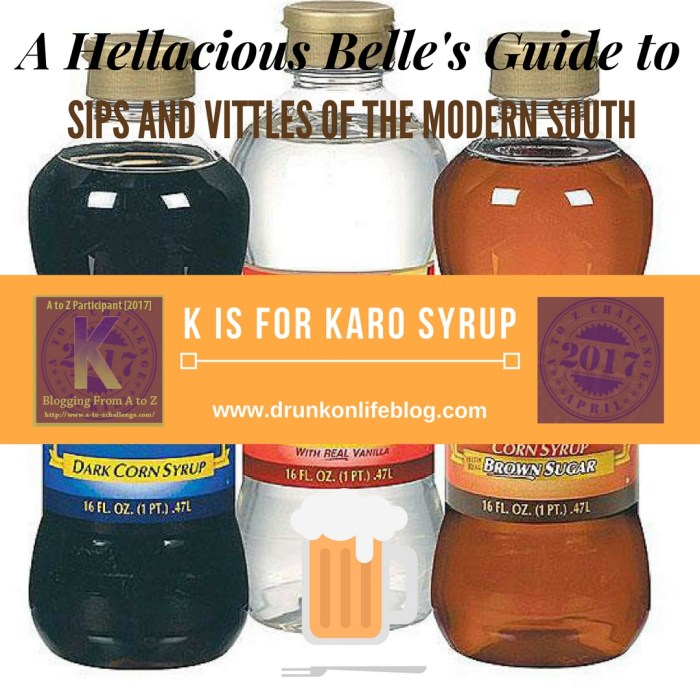
Karo Syrup is a staple of most Southern pantries. Widely used for baking, Karo comes in three varieties: light, dark and brown sugar-flavored.
It’s divine in pecan pies and divinity, a wonderful white candy my Granny used to make.
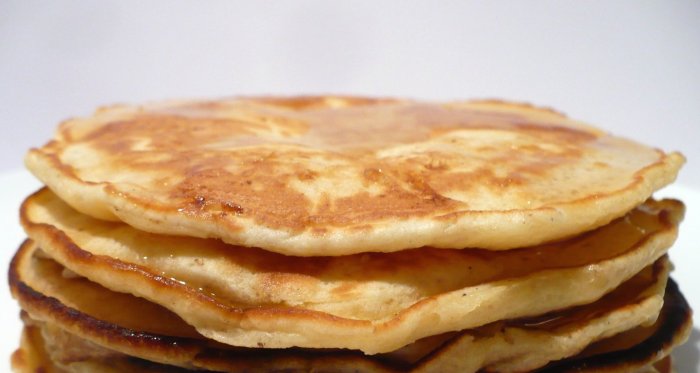
Oh, and it’s very tasty on pancakes.
Just ’cause you pour syrup on something doesn’t make it pancakes – Samuel L. Jackson

J is for Juice – Grape Juice. In honor of our current visit to Montaluce Winery, I’m sharing a previous post about Southern Wines.
As a city belle and a lifetime hospitality industry employee, I tend to think of myself as a tiny bit of a connoisseur when it comes to wine. I do say “tiny,” because not only is the industry enormous, but the varieties and varietals are almost infinite – years of study and training (and drinking!) are required to become an expert. And although I’ve had some study and training (and I’ve definitely mastered the “drinking” part) I still feel that fundamentally “it’s just grape juice,” (although sometimes truly amazing grape juice honed by masters) and there is a flavor for everyone and every palate.
Although the Southern states of Virginia, North Carolina and Texas are perhaps better known for wine making, it’s interesting to know that my home state of Georgia was once one of the largest producers of wines in the United States. Prohibition’s early start in Georgia (1907), wiped out their lead and made the industry almost non-existent until the 1970s, with the exception; oddly enough, of sacramental wine production.
Today, Georgia boasts over two dozen vineyards and wineries all over the state, although the preponderance are located north of Atlanta, in the higher elevations of Helen, Dahlonega and Cleveland.
Georgia boasts climactic conditions suited for growing Vitis vinifera (European varieties) and cold-hardy French-American hybrids used for making traditional “fine” wines. The South’s mild Springs and early Summers allow a long growing season and the higher elevations of the Appalachian foothills provide some relief from the humidity. Our famous red clay soil, a universal source of profanity after a rainstorm, actually contributes to both to excellent drainage and the ability to retain moisture during dry spells.

Vines at Montaluce, in Dahlonega, GA
Basically, this all means that the South, and Georgia in particular, is enjoying a renaissance of vinification.
How fortunate, I’ve always considered myself a “renaissance girl!”

Frogtown Cellars in Dahlonga, Georgia
Once I managed to climb over my own ridiculous snobbery about Georgia-produced wines, I fell in love with the North Georgia wine country.
We visit its rolling hills and beautiful wineries several times each year, even staying in the estate villas in Montaluce for family vacations.

Skilled winemakers and award-winning wines make it a pleasure not only to “shop,” but to “buy local.”
“Wine is one of the most civilized things in the world and one of the most natural things of the world that has been brought to the greatest perfection, and it offers a greater range for enjoyment and appreciation than, possibly, any other purely sensory thing.”
― Ernest Hemingway

It’s probably a little too much information for y’all, but for true barbecue connoisseurs, there’s deeper level to the sandwich. It goes beyond the selection of pork over beef, to the preference of “inside” meat vs. “bark,” or the amount of a mix that’s your predilection.
Traditional pulled pork barbecue is typically made from pork shoulder, a large, square cut of meat that’s topped by a thick layer of fat. When it’s cooked slowly in a pit over a low wood fire, the fat renders down, basting and tenderizing the inside meat, while the outside meat, “the bark,” browns and develops a intensely-flavored caramel crispness.
The decision on how to build your bun is all about texture and flavor – is it juicy sweet meat or chewy, smoky bark that makes for your best bite?
As you pull the meat, you toss it all together combining the soft, unctuous inside meat with the smoky, salty outside bark and the combination is the thing that foodie dreams are made of.” – Ray Lampe, “Dr. BBQ”

OMG, I have to stop writing about food for this challenge. I’m perpetually hungry and can think of nothing but making and eating all the food that I’m writing about.
Today, we look at the humble handpie, or fried pie, another traditional Southern consumable.
In theory, the handpie can be savory (and is in many cuisines, such as the divine empanadas of Hispanic culinary culture) but in the Southern United States, it’s traditionally sweet.
A single portion: rolled out biscuit dough, an aromatic filling of spices and fresh fruits (plums, peaches, apples), a quick crimp ’round the corners and a fast fry in hot oil – drain and dust with powdered sugar or a cinnamon sugar blend – maybe a drizzle of icing glaze.
A hot, palate-intensive flash of concentrated fruit flavor surrounded by sweet, melt-y, crunchy, flakey, amazing – give me one, NOW.
::sigh::

I, for one, am ready for a handout.
“We must have a pie. Stress cannot exist in the presence of a pie.”
― David Mamet, Boston Marriage

My Granny made some great gravy.
And when I say gravy, I’m not in particular talking about turkey gravy, or roast beef gravy, although she made both of those very well, as she did everything she cooked. But her white gravy was beyond perfection.
White gravy is a staple of Southern cuisine. It’s also called “milk” or “sawmill” gravy.
White gravy is what you spoon over biscuits, ladle over country-fried steak and mashed potatoes or dollop on fried chicken. It’s based on pan or bacon drippings, along with a little white flour, cold milk, some butter, salt and a strong dash of black pepper.
Perfection. Please pass the biscuits.
Some people doll it up with crumbled sausage or bacon or even roasted garlic, but to me that’s just gilding the {White} Lily, since anything more is simply…
gravy.
I come from a family where gravy is considered a beverage. – Erma Bombeck

[hahrt uh–tak onnuh pleyt]
Fried food is pretty much a staple of Southern Cuisine.
Fried chicken, of course – that’s iconic. Fried green tomatoes (with crab meat and remoulade or just plain, dusted with cornmeal). Fried okra (my favorite.) Fried pies (or hand pies – we’ll talk about those a different day.) Fried shrimp and fried crab claws, fresh off the boat and crispy hot. Fried squash (which really isn’t fried – just cooked in a skillet) and country-fried steak. Hush puppies and griddle cakes. Fried pickles with Ranch Dressing (noms.) Bacon (seriously, you can’t microwave it. You have to fry it to get the drippins for gravy.)
OMG, now I’m starving.
Fried foods are wonderful. Yeah, whatevs, not good for you, but wonderful. I’m a big proponent of enjoying them – albeit in limited quantities.
Some things, however, just shouldn’t be fried – although you’d be hard pressed to tell that to a Southern man (my Daddy in particular.) It honestly just adds insult to injury: Fried snicker bars? Fried peanut butter and banana sandwiches? Fried koolaid?
That’s the culinary equivalent of Bubba’s last words. “Hey y’all, watch ‘is!”
“You can say a lot of bad things about Alabama, but you can’t say that Alabamans as a people are duly afraid of deep fryers.”
― John Green, Looking for Alaska

 Drunk on Life
